
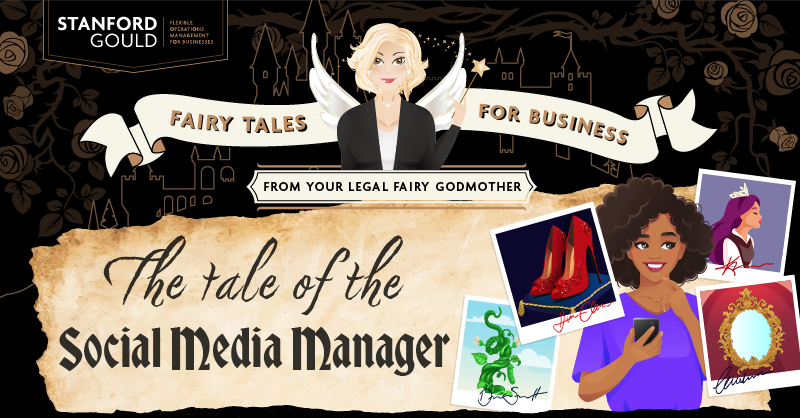
Clear terms are our Social Media Manager’s protection against messy IP disputes

In a land far away, an enterprising and spritely young thing by the name of Sophie had carved out a fantastic niche for herself running social media accounts for a whole host of creative businesses: glass slipper producers, talking magic mirror importers, beanstalk growers and tiara designers, to name but a modest few. There was magic, variety, colour, glamour and fashion in the goods and services she was asked promote and they were brilliant ‘visual dynamite’. It made pinning, Instagramming and TikToking a digital marketer’s dream.

But whilst Sophie was a dab hand at creating visual content and working around mystical algorithms for maximum reach, she wasn’t yet savvy enough to know how to tread the minefield of IP law. (A little wet behind the ears, shall we say…) All was fine and uneventful until one day, a diva of a client tried to blame her for posting content that she didn’t own the IP for. The legendary shoemaker of Tinseltown Jimi Choux was asserting his right to some images of his coveted red slippers, because Mariah hadn’t yet paid him for the bespoke spiked heels. His own contract stipulated IP didn’t transfer until payment had been made! (Guess where he had that contract?)

Sophie, nervous and confused sensed a nasty storm brewing and wisely turned to The Legal Fairy Godmother for advice.

“Who really owns the images? When can I safely use them? And if I own them, when does ownership pass from me to my customers? Who can use these posts and images afterwards? How do I know where images are taken from and… are intellectual property toes being trampled if I repost or use them as part of my own social media campaigns…?!” Sophie, full of panic, was all but blubbing into the perfectly mixed Aperol Spritz she’d just Instagrammed at the trendy bar where they’d rendezvoused.

“My dear Sophie,” the Legal Fairy Godmother soothed, “…would you please get a hold of yourself and calm down!” She waved a shimmering scroll in the air that turned out to be a template contract for people in Sophie’s line of work. She explained –  “This magical document makes sure all these IPR challenges and more are taken care of, limiting your liability so that in the event of being provided some visuals of unknown origin, you can lay the blame for their wrongful use squarely at the door of the fool who gave them to you.”

“Phew,” Sophie smiled and mopped her brow. “Thank you Legal Fairy Godmother!” “Don’t mention it,” she replied, ordering two more cocktails. “Now go forth and reflect on your near miss – and thank goodness for Your Legal Fairy Godmother’s template contract for social media managers!”

Want to know more about Intellectual Property Rights? Click here.
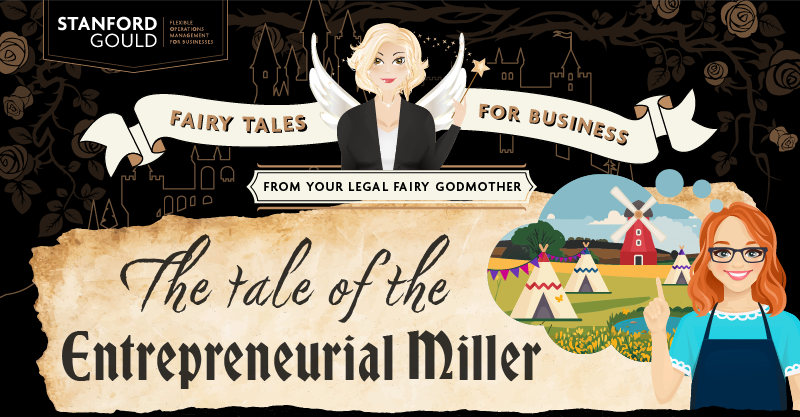

No carbs before Marbs means our breadwinner needs to diversify

Far, far away, in a land of rainbows and butterflies, there was a pretty little mill owned by a young miller nestled beside a meadow of wildflowers and a pond full of sticklebacks. It was picture perfect. In fact it wasn’t just picture perfect, it was ‘a hilltop Julie Andrews number’ away from simply iconic. Millie loved her home and everything it provided. Complete with cute windmill, it gave her everything she needed to be self sufficient. (She hadn’t even had to suffer that dreadful marriage thing, for a second income.) What an incredible and liberating way to make a living!

Alas, circa 2018, every man (and woman) in the land and even their dogs, started avoiding carbs or became allergic to gluten. Marbella and its many other fancy Mediterranean counterparts gave rise to the dastardly idea of being beach body ready. Meanwhile, Betty the vicar’s wife wasn’t planning to go further than Ingoldmells and she certainly wasn’t going to be sporting a two piece. But she had another problem – “Oh bread, Millie, it bloats me! Bloats me, I tell you! I have enough flatulence to power your windmill!” And so it transpired, once an honest and noble way to make a living, breadmaking had fallen well and truly out of vogue.

Our miller took some time to think. One day in a burst of inspiration she envisioned her land as the backdrop to a mini festival, a wedding, in fact any kind of party – yes, it was the perfect blank canvas for an event. “My meadow would be the perfect spot to set up a tipi and some yurts for folk to have a truly fabulous gathering in the English countryside. But how do I pull this off?” Millie scratched her head.

Suddenly there was a flash and a sparkle of fairy dust and her Legal Fairy Godmother appeared, and exclaimed – “Your idea is fantastic, young lady. But be sure to get your Health and Safety groove on, talk to your insurance broker, and grab yourself a ready to use contract template for Field Hire from our website to make sure you have covered all your legal and compliance bases.”

Are you looking to pivot or diversify your business? Take a look at this blog which offers some crucial advice for ‘freelancers’.

Business Fairy Tales from Your Legal Fairy Godmother

Business Fairy Tales are stories that often exaggerate or idealize the success of a company or entrepreneur.

They usually portray a narrative of rapid growth, instant success, and overcoming obstacles effortlessly. These tales often focus on individuals who start with nothing and quickly achieve great wealth or fame through their business endeavours.

However, they may overlook the challenges, failures, and hard work that are typically part of the entrepreneurial journey. In reality, success in business usually involves persistence, resilience, and a willingness to learn from mistakes.

Sounds more realistic, right?

How about hearing some Fairy Tales that really might help your business- no matter how small or large, or simple or complex you are, no matter what sector, or service, or industry?

Read our cautionary tales for business owners and entrepreneurs created by Your Legal Fairy Godmother for a bit of education and entertainment – delivered monthly to your inbox.

Discover the enchanting world of business through the captivating tales spun by Your Legal Fairy Godmother.

Dive into insightful narratives that blend law, wisdom and imagination, illuminating the path to entrepreneurial success.

Sounds good? It couldn’t be simpler to get your copy:

Click here to sign up today or go to our Stanford Gould website RESOURCES tab and join us for the first edition next week (end February 2024) when we wave a magic wand to sprinkle some Legal Fairy Godmother magic over your small business, with tips and solutions you might find helpful.

You are very welcome

Freelance Wedding Supplier Contracts: 3 Things You Must Include

Freelance wedding supplier contracts; do you really need one?

As a business owner, if you are:

  • pivoting your business
  • expanding rapidly in the post-covid ‘brave new world’ of opportunity
  • thinking you need some extra hands on deck
  • looking to diversify your offered services?

…you’ll be needing a contract for that!

Whether you are the business looking to take on self employed extra capacity quickly, or a freelancer thinking, “It’s about time I set something up in writing” (yes, it is!) we now have solutions that won’t break the bank at Stanford Gould Online.

freelance contracts; templates

Make sure your contract for services covers these 3 important issues:

One

Define what you are doing and how you are going to get paid in your freelance wedding supplier contracts. 

Most people get this right, but make sure it is in writing – charges per hour, per day or per project need to clear. Think about overtime, extras, variations and project creep (work outside the scope of the original proposal – we’ve all been there!) – these all need to be covered too.

Two

Make it as clear as possible that you are NOT an employee and this is a contract for services, not a service contract.

Sounds like a right lawyer’s distinction, doesn’t it? This is an important one in your freelance wedding supplier contracts, though. No contract can completely remove the risk of scrutiny of your employment position by HMRC or the Employment tribunal (take a look at this blog we wrote for salon owners recently too…), but it is important to set out some areas of what you provide and how you may ‘control’ your freelancers in their contract. It can be very problematic if your organisation provides self-employed contractors with uniforms, equipment, office space, insurance or vehicles, or if you insist they attend a particular work place between particular times – so take some advice! If the contract sets this out clearly this can help, but will not be definitive – just ask an Uber driver….

Three

What’s your escape plan?

Does your contract have a notice period to terminate the contract for services that will work for both parties? Does it also allow for immediate termination in some situations, such as a failure to pay or an insolvency situation?

Two versions of our freelance wedding supplier contract template are available – one for the business taking on the freelancer, and one for a freelancer to provide to any business they intend to work for and provides services to. 

If you are a wedding supplier or freelancer, you can take a look at the version created specifically for the wedding sector on our dedicated website and services for wedding suppliers here.

3 Freelancing Tips; Things To Know As A ‘Newbie’

Hi, let me introduce myself. My name is Giselle (that’s me on the left in the image below!) and I am working as a freelancer at Stanford Gould. I have been a freelancer for four months now, and I want to share my three biggest freelancing tips, the things that I have learnt in that time, and the mistakes I’ve made – so you don’t have to! 

Image by Megan Wilson

Tip one – Planning ahead

I work as a freelancer part-time along with my university studies so one of the biggest things I have learnt is how to effectively time manage – that means a lot of planning ahead! 

One of the obvious benefits of freelancing is the flexibility and freedom in how and when we work since there is no rigid 9-5 office structure; you are essentially your own boss.

However, freelance work still requires high standards of work to be produced, usually to tight deadlines. This is normally a juggling act of balancing various tasks, projects, and assignments which can be a pressurised situation, leading to a LOT of stress. 

So, it is essential to be able to balance our work and this requires some planning ahead. 

What is my method and the first of my freelancing tips?

I really like to have my weeks planned out beforehand. I rely heavily upon my diary for planning the upcoming months. (I use an app called Notion that I would really recommend having a look at.)

Planning for me does not only include separating the tasks but also prioritising and, most importantly, awarding enough time to complete the tasks well. This can sometimes be missed since we are busy packing the work into our weekly schedules, however being realistic about our own abilities is a skill that is essential to time management. 

There is no point planning to do 30 hours of work in 10 hours if you physically cannot produce the work to that rate. I learnt this from a few past mistakes, and it did not end well (oops – lesson learnt!).

The ability to realise your own work rate and potential is key to creating realistic and achievable plans to allow you to complete your work effectively. It can also help take off some of the stress in the working week. 

Tip two – Finding motivation!

The pandemic has shifted everybody into a new state of working including WFH, or working from home, as the new normal. 

As freelancers it is often easy to find working from home a benefit to create flexible working, however there is also a particular ease to getting distracted or losing motivation as you’re sitting at your desk in your room. 

So, what motivates you? Working this out is key to the second of my freelancing tips! 

Personally as a university student I know there is always the tendency to order lots of takeaways and go out too much, ignoring the work I have to do. However, this pandemic has been a wake-up call on how to self-motivate and how to keep that motivation over a prolonged period of time. 

We all know it is easy to give ourselves a pep talk to motivate us to complete the final hour of the project before a deadline, however how do you keep that motivation for longer than just that day?

It is true there will always be ‘off days’ but working on motivating yourself for most of your working time is essential to being a successful freelancer. 

So, what’s my method? 

There are various ways to keep motivated, however here are some that have worked for me. These are not drastic changes or routines to stick to, but easy little changes that help motivation. 

These include:

  • Creating your own structure – a structured routine that sets boundaries for when you are going to work prevents you being mentally exhausted or burnt out. 
  • Being healthy – sounds simple but this improves brain function and the ability to focus by eating well, exercising and getting enough sleep. 
  • Allowing time for breaks – this can be short 20 minute breaks or a break to go on holiday. Both are just as effective in sustaining motivation long-term. 
  • Adopting a good work / life balance – the beauty in not working all the time and taking a little bit of time to do something different is so useful to keep a work / life balance. 

Obviously, all these ideas work differently for different people and there is no winning solution, however little changes can help improve our motivation and focus in the long term. This is one of the things I have learnt and would definitely suggest giving it a go!

Tip three – Learning to enjoy the job

Image by Megan Wilson

As freelancers we are our own bosses, and this usually means we have chosen the path in which we want to produce freelance work – so let’s embrace that. This is the last of my freelancing tips!

Yes, there may be bad days or boring projects that you would love to never see again, however you are working in an area that you love or that you are passionate about. This is a sense of fulfilment that many people strive to have in their careers. 

Freelancing may be a difficult job, however one of the perks is definitely the control and freedom of working for yourself, and how you make your job enjoyable is part of that. This is one of the biggest things I’ve learnt in my journey as a freelancer so far – to enjoy and appreciate the job. 

I hope this shed some light on the work of a freelancer and some of the things I have learnt. 

P.S next 14th May you can celebrate national freelancer day! 

If you’re a freelancer looking for a contract template, you can find those HERE.